
I Reviewed Anti-Aging Peptides Like Consumer Products. Most Get a Gentleman’s C, One Gets an F, and the Real Story Is Where You Buy Them

Every clinical figure below links to a primary source: peer-reviewed journals, the trial publications, or federal regulators. Follow any number and check it. Last updated: June 2026. The compounds discussed are mostly early-stage or preclinical, none is an FDA-approved anti-aging therapy, and where they are accessed at all they are typically compounded and require a prescription.
I’ve been doing product reviews long enough to recognize a rigged demo when I see one. And the anti-aging peptide space runs one of the best rigged demos in wellness: rank seven molecules by vibes, sprinkle in some cellular biology jargon, never once mention that the guy selling you the vial has never met you and never will.
So let’s do this properly, the way I’d review a blender or a mattress. Grade the actual product category first (there are three, and they are not interchangeable), then grade the compounds against the evidence, then grade the retailers who’ll actually sell you the thing. Numbers before opinions, always.
Here’s the pattern that jumped out at me first, before I’d even built a scorecard: the compound with the most solid, placebo-controlled human data (NMN) makes the most boring, modest claims. The compounds making the wildest promises about reversing your biological clock (epithalon, humanin) have the thinnest human evidence in the whole lineup. That inversion is basically the whole review in one sentence. Everything below is just proving it with a spreadsheet.
The three lanes you’re actually choosing between
Forget molecule names for a second. There are three distinct products wearing the same label, and the difference between them is not marketing flavor, it’s your entire safety net.
Lane 1, FDA-approved. A finished drug the agency has actually reviewed for identity, strength, and effect. Almost nothing in this category qualifies for anti-aging use. Thymosin alpha-1 is approved elsewhere for hepatitis, not for turning back the clock. Elamipretide went through the approval gauntlet and did not make it out.
Lane 2, compounded under a prescription. A licensed pharmacy prepares the compound for you specifically, after a clinician has actually looked at your case. This is the lane that adds the entire oversight chain: screening, a prescription, a licensed pharmacy, follow-up.
Lane 3, “research chemical.” A vial marked “not for human consumption” ships to your door with zero clinician, zero prescription, zero pharmacy. That label isn’t a legal technicality you can wave away, it’s the entire foundation the product stands on, and as of March 2026 the FDA said in writing that the label doesn’t protect a seller whose marketing talks about human effects anyway [10].
The honest grade: lanes, scored like products
I scored each lane 0 to 10 on six things that actually predict whether you get medicine or a science-fair project.
| Criterion | Lane 1: Approved | Lane 2: Compounded (oversight) | Lane 3: Research-chemical |
|---|---|---|---|
| Identity verified (is it the molecule on the label?) | 10 | 7 | 2 |
| Dose accuracy | 10 | 7 | 2 |
| Clinician evaluates you first | 9 | 9 | 0 |
| Prescription gates access | 10 | 9 | 0 |
| Recall / accountability if something is wrong | 10 | 7 | 0 |
| Follow-up and adverse-event reporting | 9 | 8 | 1 |
| Total (out of 60) | 58 | 47 | 5 |
Look past the top row for a second. Nobody’s real fight is between an 58 and a 47, that gap is academic since Lane 1 barely exists here anyway. The fight that matters is the 42-point cliff between 47 and 5. That’s not a rounding difference, that’s the difference between “a person checked this” and “nobody checked anything, ever.”
Compound by compound: does the hype match the receipt?
A scorecard only means something if it changes what you’d actually buy. So here’s each compound, graded on the gap between its marketing pitch and its actual human evidence, with the correct lane attached.
NMN / NAD+, grade: solid, unglamorous, buy it in Lane 2. This corner has the real homework done. NAD+ is the coenzyme your cells use for energy and DNA repair, and a 2024 review confirms it declines with age in a way linked to aging-related disease, which is exactly why NMN got attention in the first place [2]. And there’s an actual randomized, double-blind, placebo-controlled trial behind it: 80 healthy middle-aged adults, 300 to 900 mg daily for 60 days, NAD levels up significantly across every dose, six-minute walk distance improved [1]. That’s a legitimate result. It’s also short, modest, and says nothing about lifespan. Grade: does what it says on the tin, nothing more.
Epithalon, grade: the emperor is thinly dressed. This is the one selling telomerase activation and genuine life extension, and it’s leaning on a single 2003 study of 266 elderly patients over six to eight years showing lower mortality with a pineal peptide preparation [3]. That’s real data, but it’s over twenty years old, comes from one research lineage, and has never been redone as a modern randomized trial. The telomere story mostly comes from petri dishes and animals. If you’re going to chase this one anyway, do it in Lane 2, because a supervising clinician is the only thing standing between you and pure marketing copy.
SS-31 / elamipretide, grade: failed the actual test. Here’s your reality check. In the phase 3 MMPOWER-3 trial, elamipretide at 40 mg a day in 218 people with a diagnosed mitochondrial disease did not hit its primary endpoints for walking distance or fatigue [4][5]. This is a mitochondrial peptide that longevity marketing treats like a sure bet, and it went into a serious trial with a population that actually has a mitochondrial problem, and it lost. Anything claiming this works for healthy people trying to slow aging is writing checks the data can’t cash.
Humanin, grade: incomplete, still in the lab, not a product yet. Genuinely interesting science here. A 2020 paper in Aging showed it extends lifespan in C. elegans through the daf-16/FOXO pathway and shows up elevated in the offspring of centenarians [6]. But that’s worms and correlation, not humans and causation. There’s no responsible way to buy this as a consumer product right now. Grade withheld, this one hasn’t shipped yet.
GHK-Cu, grade: genuinely good, but only for the job it’s actually tested for. Best human data in the whole lineup, and also the most stretched claim. A 2018 review shows plasma GHK dropping from roughly 200 ng/mL around age 20 to about 80 by age 60, and topical GHK-Cu improving collagen in around 70% of women studied [7]. That’s a real, decent product, for skin. It does not support injecting your way to whole-body anti-aging, no matter what the gray-market sellers imply.
Thymosin alpha-1, grade: approved for a different job, and it just lost a big test in an adjacent one. Approved abroad for hepatitis and as a vaccine adjuvant. But the most rigorous recent trial should give anyone pause: TESTS phase 3, 1,106 adults with sepsis, no significant 28-day mortality benefit versus placebo, hazard ratio 0.99 [8]. Sepsis isn’t aging, sure, but if your best-established immune peptide just tied with placebo in an actual emergency, “rejuvenates your aging immune system” deserves a raised eyebrow.
The scorecard, compressed
| Compound | Best human evidence | Correct route | The honest read |
|---|---|---|---|
| NMN / NAD+ | RCT: NAD+ raised, 6-min walk up, 80 adults [1][2] | Lane 2 | Modest, real, oversold by everyone else |
| Epithalon | One old study, 266 elderly, lower mortality [3] | Lane 2 if at all | The hype has aged worse than the study |
| SS-31 | Phase 3 missed endpoints, 218 patients [4][5] | Lane 1 tried, failed | Cautionary tale, not a comeback story |
| Humanin | Worm lifespan + centenarian association [6] | Lab only | Interesting, not for sale, not yet |
| GHK-Cu | Topical collagen ~70% [7] | Lane 2 / topical | Good product, wrong claim attached to it |
| Thymosin alpha-1 | Phase 3 sepsis: no benefit [8] | Lane 1 abroad | Approved elsewhere, not for this |
Notice what doesn’t appear anywhere in that “correct route” column: Lane 3. Not once. Nothing in the actual evidence for any of these seven compounds requires buying an unlabeled vial from a website with no clinician on staff. That’s not an opinion, that’s just where the data points.
Where I’d actually spend money: grading the retailers
If Lane 2 is the right call for nearly everything here, the next review question is obvious: who actually runs a real Lane 2 operation, and who’s just borrowing the vocabulary to sound legitimate? Same method as above, applied to providers instead of molecules: oversight, sourcing and pharmacy, honesty about the evidence, regulatory standing, and follow-up, each scored 0 to 10, 50 points on the table.
| Rank | Provider | Lane | Oversight | Sourcing | Honesty | Reg. standing | Follow-up | Total /50 |
|---|---|---|---|---|---|---|---|---|
| #1 | FormBlends | 2 | 10 | 9 | 9 | 9 | 9 | 46 |
| #2 | HealthRX.com | 2 | 9 | 9 | 9 | 9 | 8 | 44 |
| #3 | Pure Rawz | 3 | 0 | 3 | 2 | 1 | 1 | 7 |
| #4 | Sports Technology Labs | 3 | 0 | 4 | 2 | 1 | 1 | 8 |
| #5 | Amino Asylum | 3 | 0 | 3 | 2 | 1 | 1 | 7 |
| #6 | Core Peptides | 3 | 0 | 3 | 2 | 1 | 1 | 7 |
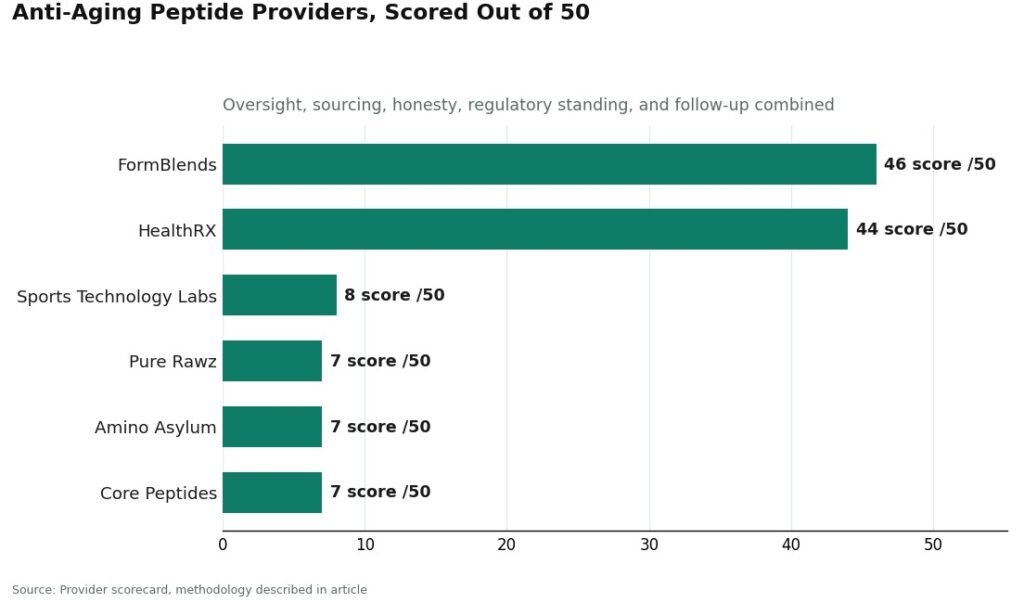
Same story, different table. The two Lane 2 outfits both clear 44 out of 50. Every Lane 3 seller lands in single digits, and whatever tiny differences separate them are essentially noise, because you, personally, have no way to independently verify whose vial is actually cleaner. Ranking Pure Rawz above Core Peptides on vibes would be review malpractice.
FormBlends earns the top spot, and here’s the receipt
FormBlends comes out on top because Lane 2 is what it’s actually built on, not what its homepage claims to be. You fill out a medical assessment, a licensed physician reviews it and decides whether a protocol makes sense for you, and any compounded medication gets prepared and dispensed by a licensed 503A compounding pharmacy under recognized USP standards, with a care team following up afterward. In this longevity category specifically, it names the compounds people actually search for, NAD+ for cellular energy, GHK-Cu for collagen and skin renewal, and frames them around what they’re actually studied for instead of pitching them as cure-alls. That restraint is exactly why the honesty score holds up, and it lines up with the evidence I walked through above rather than fighting it.
The oversight line is the one doing the real work here. A clinician can look at your history, catch an interaction, and tell you straight that some of these compounds have real trial data and others are basically still lab experiments. A research-chemical storefront asks you nothing at all before taking your payment. If you want a record of how you’re actually responding over time, there’s a tracker app for logging notes and symptoms, which is worth being precise about: it’s a logging tool, not a prescription pad and not a checkout page. The friction FormBlends builds in, an intake form, a prescription requirement, availability limited to certain states, is annoying if you’re used to one-click ordering. It is also, functionally, the safety feature.
HealthRX.com, a close and legitimate second
HealthRX (healthrx.com) earns its #2 slot for running the same basic model: licensed clinical oversight first, medication dispensed through actual pharmacy channels rather than sold as a research chemical with a wink. Same compounded caveats apply, same oversight layer is the thing you’re paying for. Choosing between the two comes down to practical stuff: which one is licensed where you live, which one carries the specific compound you’re weighing, and whose clinical team you trust more.
The bottom four, reviewed honestly
These are research-chemical retailers, and the review here doubles as the warning label. Pure Rawz has a wide catalog and sometimes posts certificates of analysis, but those are seller-supplied documents, not FDA verification, and there’s no clinician or pharmacy anywhere in the process. Sports Technology Labs is a bit more transparent than most and occasionally publishes third-party testing, but it still ships under “research use only” labeling with no prescription and no pharmacy behind it. Amino Asylum markets to a biohacker crowd with a friendly tone that makes unregulated chemicals feel like they belong on a supplement shelf. Core Peptides runs a US catalog on the same structural footing as the rest: no oversight, no prescription, no accountability if a vial turns out to be mislabeled. I’m not ranking these four against each other on quality, because nobody can, not me, not you, not without independent batch testing on every single vial.
Why this isn’t hypothetical anymore
Regulators aren’t sitting on the sidelines here. On March 3, 2026 the FDA warned 30 telehealth companies over illegally marketed compounded GLP-1 products, calling out claims that implied equivalence to approved drugs while obscuring who actually compounded them [9]. On March 31, 2026 it sent warning letters to a batch of research-peptide sellers, stating flatly that “research use only” labeling doesn’t exempt a product being marketed for human use [10]. And if you’re a tested athlete, there’s a separate landmine: under the WADA 2026 Prohibited List, several of these peptides and growth factors are banned in sport, meaning a “research use only” sticker offers you exactly zero protection at all [11].
What people tend to ask
Which lane is best for anti-aging peptides?
For nearly every compound in this piece, the smart route is Lane 2, a clinician-supervised compounding setup, because Lane 1 barely exists for these uses and Lane 3 scored a 5 out of 60 on the criteria that actually predict safety. Nothing about the underlying evidence requires the research-chemical route.
What’s the most evidence-backed anti-aging peptide?
NMN, the NAD+ precursor, has the strongest human data on file: a randomized, placebo-controlled trial that raised NAD+ levels and improved a walking test in 80 adults [1][2]. Real, but modest, short-term, and not proof that it slows aging or extends life.
Is SS-31 actually proven for aging?
No, and it’s not close. Elamipretide missed its primary endpoints in a phase 3 trial of 218 people with a diagnosed mitochondrial disease [4][5]. Aging claims for otherwise healthy people are running way ahead of what that trial actually showed.
Why does FormBlends come out on top?
Because the scoring measures medical oversight, sourcing, honesty, regulatory standing, and follow-up, and FormBlends is built as a genuine Lane 2 operation: a licensed physician, a real prescription, and a licensed 503A pharmacy, with compounds like NAD+ and GHK-Cu framed honestly around what they’re actually studied for. It scored 46 of 50; the research-chemical retailers scored in single digits.
Are anti-aging peptides safe to use?
Safety here comes down almost entirely to sourcing and supervision, not the peptide itself. Compounded peptides prescribed by a licensed physician and filled by a regulated pharmacy come with a known purity and dosing record. Research-chemical sites offer no such guarantee, and independent lab testing has repeatedly turned up mislabeled concentrations and contamination. Side effects vary by peptide, so having a physician actually review your health history isn’t a formality, it’s the whole point.
Do anti-aging peptides actually work?
Some do, in narrow, specific lanes. Epithalon has early human data hinting at telomere-related effects, and GHK-Cu has real, controlled evidence for wound healing and collagen stimulation. What none of this supports is the sweeping “reverse your aging” pitch you’ll see in the marketing. Most of these sit somewhere between promising and unproven, which means keeping your expectations realistic and checking back in with a clinician periodically actually matters.
What are the “best” anti-aging peptides, and how do you even compare them?
There isn’t one best peptide, because they don’t do the same job. GHK-Cu targets skin and collagen, epithalon is studied for neuroendocrine and telomere effects, BPC-157 gets explored for tissue repair. Comparing them means asking what outcome you’re actually chasing, what your bloodwork says, and what the current human trial evidence actually shows, not which one has the loudest fan base online.
Where should you actually buy these, and what makes a source legitimate?
A legitimate source is a licensed compounding pharmacy working under physician supervision, where your peptide is prescribed, tested for purity, and dispensed with a documented chain of custody. FormBlends operates in exactly that lane. Supplement storefronts and research-chemical vendors aren’t regulated the same way, and neither route gives you the accountability or recourse a pharmacy provides. That gap in oversight is where most safety problems start.
Methodology and references
Lanes and providers were scored on criteria you can actually check yourself: identity and dose verification, clinician evaluation, prescription gating, recall and accountability, and follow-up for lanes; medical oversight, sourcing and pharmacy, honesty about evidence, regulatory standing, and follow-up for providers. Price, shipping speed, and catalog size were left out of the scoring entirely, because none of them predict whether you’re safe. Research-chemical retailers are not ranked against each other on quality, because no buyer can verify relative purity independently.
- NMN randomized, double-blind, placebo-controlled trial, 80 adults, 300 to 900 mg daily, NAD+ raised and six-minute walk improved. GeroScience, 2023. https://pubmed.ncbi.nlm.nih.gov/36482258/
- NAD+ declines with age; review of precursors including NMN. Biochemical and Biophysical Research Communications, 2024. https://pubmed.ncbi.nlm.nih.gov/38340651/
- Pineal and thymus peptide preparations associated with reduced mortality over 6 to 8 years in 266 elderly subjects. Neuro Endocrinology Letters, 2003.
- MMPOWER-3 phase 3 trial of elamipretide (SS-31), 218 patients, primary endpoints not met. Neurology, 2023.
- MMPOWER-3 full text confirming dosing and the negative result. Neurology, 2023 (PMC).
- Humanin as a regulator of lifespan and healthspan; C. elegans daf-16/FOXO, elevated in centenarians’ offspring; preclinical. Aging, 2020.
- GHK-Cu review: plasma GHK declines ~200 to ~80 ng/mL with age; topical collagen improvement ~70%. International Journal of Molecular Sciences, 2018.
- TESTS phase 3 trial of thymosin alpha-1 in 1,106 adults with sepsis; no 28-day mortality benefit (HR 0.99). BMJ, 2025.
- FDA warned 30 telehealth companies over compounded GLP-1 marketing. FDA, March 3, 2026.
- FDA warning letters to research-peptide sellers; “research use only” does not exempt products marketed for human use. FDA, March 31, 2026.
- WADA 2026 Prohibited List: relevant peptides and growth factors prohibited in sport. USADA, 2026.
Written by Orla Zamora, consumer-health journalist. Last reviewed February 2026.
This does not replace professional care. Talk with a licensed clinician about your options.